From Decoding to Understanding: Practising Text Comprehension with Read & Answer
Here is a scene almost every parent of a six- or seven-year-old will recognise. Your child reads a sentence out loud. Every word is correct. Not one letter is missed. You ask, gently, "So what happened?" — and your child looks up, completely blank.
Nothing has gone wrong. What you just watched is the single most important gap in learning to read: the gap between decoding a text and understanding it. Reading is not the recognition of letters. Reading is understanding what the letters say. Everything before that is machinery.
📚 The path is longer than most parents expect
Children build reading in stages, and each one has to be practised on its own:
Letters → Syllables → Words → Sentences → Understanding
Most families work hard on the first three. Letters get flashcards, syllables get clapped out, words get read aloud at bedtime. And then the assumption quietly takes over that the last step happens by itself — that once a child can read, understanding simply follows.
It often does not. Understanding is a step like the others, and like the others it has to be practised.
🧠 Why automatic reading is the precondition for understanding
The reason has nothing to do with intelligence. It is about attention, and how little of it we have.
Reading asks a child to do two jobs at the same time: turn marks on a page into words, and turn words into meaning. A beginning reader spends nearly all of their available attention on the first job. Sounding out b–u–t–t–e–r–f–l–y uses up so much working memory that by the time the last letter arrives, the beginning of the sentence has already faded. There is nothing left over for meaning.
This is why automaticity matters so much. When letters, syllables and words become automatic — recognised instantly, without conscious effort — attention is freed. And freed attention goes exactly where it is needed: to connecting ideas, holding the sentence together, answering the question what is this text telling me?
Practice is what makes a skill automatic. That is true of letters, it is true of words — our article on reading fluency in 1st and 2nd grade covers that part in detail — and it is just as true of understanding. Children need repeated opportunities to read something, think about it, and respond to it.
🔬 What the research actually says
That decoding has to become automatic before understanding has room to happen is not a hunch. It is one of the oldest and best-supported ideas in reading research — and it is worth being precise about what has been shown and what has not.
The theoretical statement is over fifty years old. LaBerge and Samuels argued in 1974 that because attention is a limited resource, decoding has to become automatic so attention can be redirected to meaning. Perfetti's later lexical quality hypothesis sharpened it: the more precise and readily retrievable a child's stored word representations are, the more reliably meaning arrives.
The empirical picture since then:
- Fluent text reading is the link between word reading and comprehension. Kim and Wagner followed 316 children annually from Grade 1 to Grade 4. In Grade 1, text reading fluency added nothing beyond word reading and listening comprehension. From Grade 2 onward it completely mediated the relationship between word-reading fluency and reading comprehension — word-level skill reached comprehension through fluent text reading, not around it.
- Automaticity is not the same as knowing the words. Roembke and colleagues tested 58 middle-school students on tasks that separate knowing a letter-sound mapping from retrieving it fast. Decoding was predicted by knowledge; reading fluency was uniquely predicted by automaticity. (In that study automaticity did not predict comprehension directly, and the sample was small — the finding is about fluency.)
- Speeded practice on the small parts works. Metsala and David worked with children who read words accurately but slowly. Mastery on speeded practice of sublexical spelling patterns — syllables and letter clusters — predicted fluency gains beyond what pre-test fluency and word-reading accuracy already explained.
- The framing is current. A 2026 study by researchers at East Tennessee State University, Michigan State University and the University of Utah opens with the position stated plainly: "Fluency is a multidimensional construct that requires automaticity with foundational skills. Fluency is not an end in itself but serves as a bridge between decoding and reading comprehension."
German-language research points the same way. In the Frankfurt Hauptschulstudie, Gold and colleagues examined 527 sixth-graders and found reading fluency, vocabulary and reading motivation to be the primary determinants of text comprehension — for children with and without a migration background alike.
One honest caveat. None of this is evidence that ABC Smash works. Showing that would mean studying ABC Smash itself, and we have not done that. What the research supports is the learning mechanism the app is built around:
Foundational decoding skills need to become increasingly automatic so that children can devote their attention to understanding what they read — and the Read & Answer lessons give children repeated practice in making the essential connection between reading words and understanding meaning.
That is a claim about the design, not about a measured outcome. It is also the one we are willing to defend.
✏️ Understanding is also where writing starts
There is a second reason not to treat comprehension as an afterthought. Understanding is not only the goal of reading — it is the foundation of writing.
To write, a child has to understand how language works, connect ideas to one another, build meaning deliberately, and put a thought into words that someone else can follow. Every one of those is the same skill that comprehension practice builds, just running in the opposite direction. A child who can reliably extract a fact from a sentence is much closer to being able to put one into a sentence.
And the mechanism repeats itself: the more the basics are practised, the more automatic they become; the more automatic they become, the more mental capacity is left for thinking, understanding, communicating and writing.
🔍 What "Read & Answer" actually does
This is the exact gap the new Read & Answer lesson in ABC Smash was built for. It is the app's newest and hardest lesson, marked 9+ in the lesson picker, and it is the first one where reading a single word correctly is not enough.
The board is simple. A sentence appears at the top. Underneath it, in gold, a question about that sentence. Around the room, answer words drift past. The child reads, works out which word answers the question, and taps it.
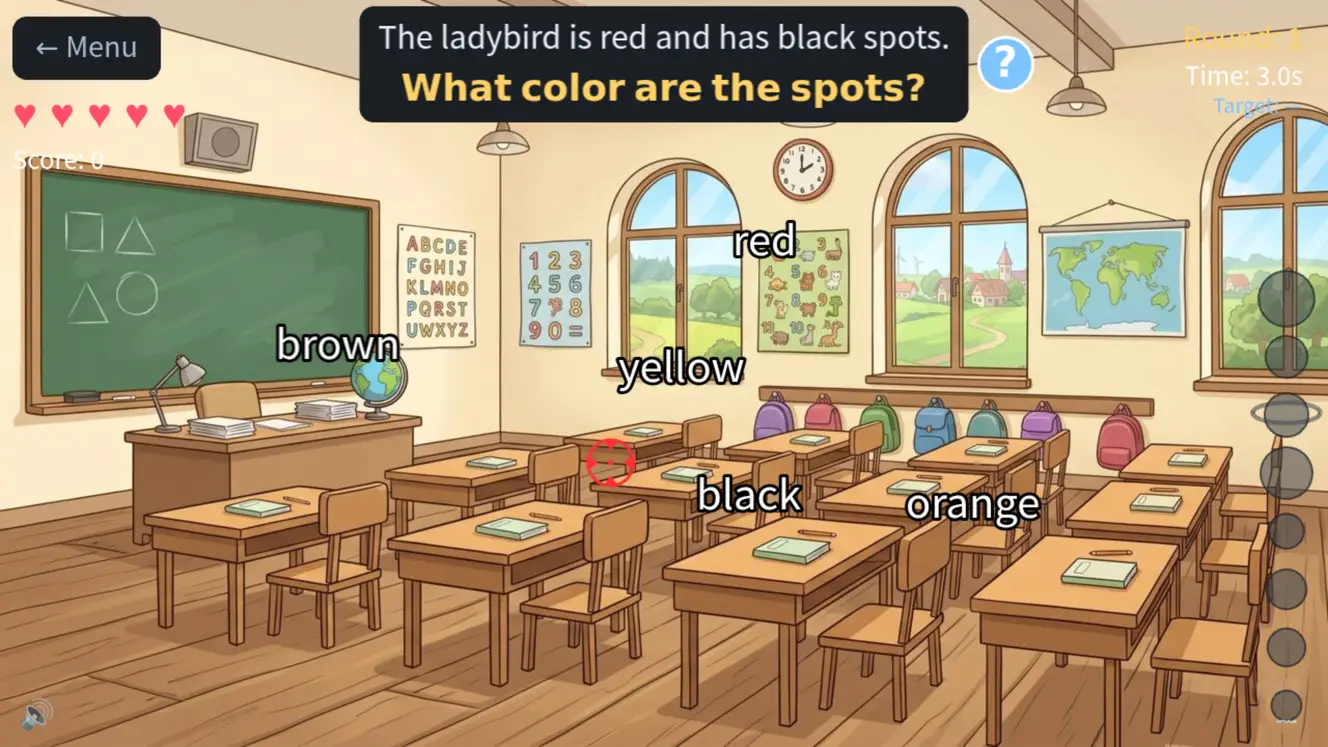
"The ladybird is red and has black spots."
What color are the spots?
On the board: brown · red · yellow · black · orange. The answer is black.
Look closely at why that is harder than it sounds. The sentence contains two colours, and both of them are on the board. A child who does not read the sentence — who just looks for "the colour word" — has a fifty-fifty chance at best. Red is not a random distractor. It is the mistake a real child actually makes, and it is sitting right there in the sentence.
That is the design rule the whole lesson is built on: every sentence names two rival answers of the same kind, attached to two different things, and every sentence carries two questions — one for each thing. Guessing stops working. The only way through is to read the sentence, read the question, and work out which one refers to which.
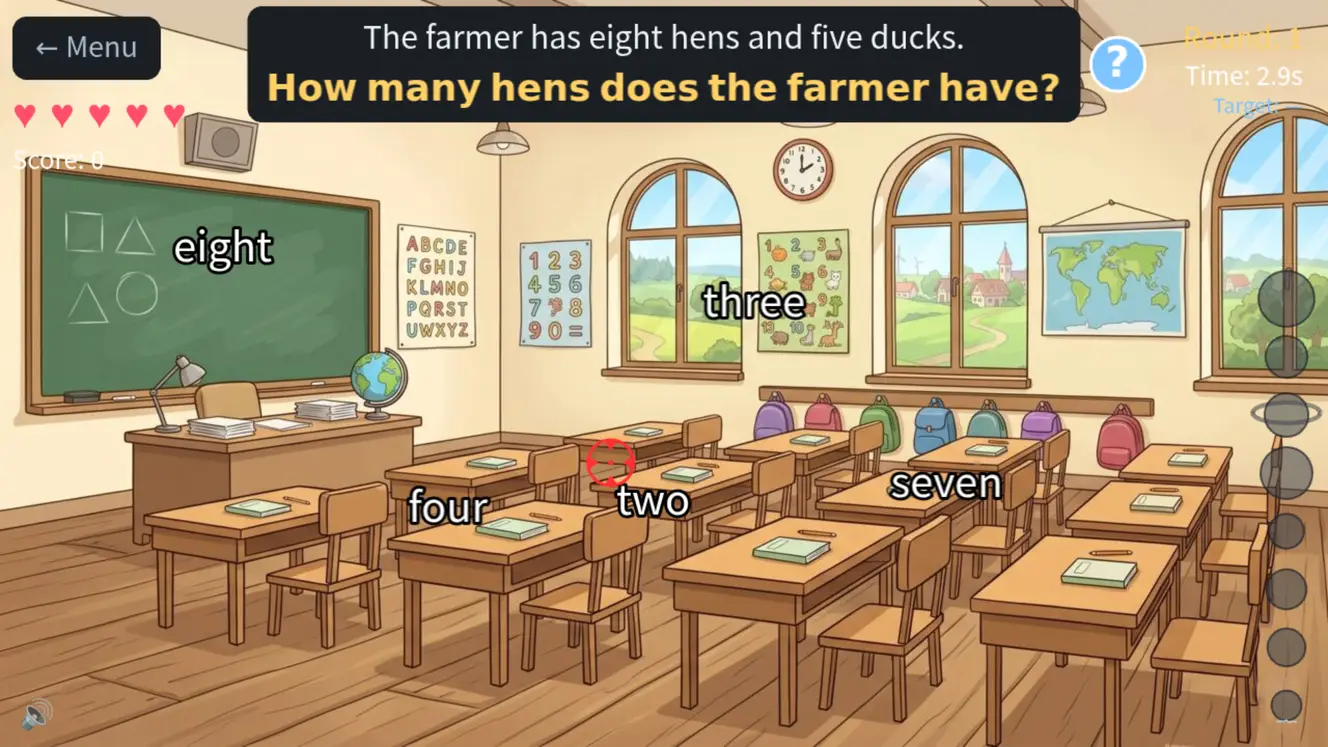
"The farmer has eight hens and five ducks."
How many hens does the farmer have?
On the board: eight · three · four · two · seven. The answer is eight.
Because the answer has to come from the sentence, world knowledge does not help and grammar does not help. That is deliberate. It is what separates this lesson from a fill-in-the-gap exercise, where a child can often land on the right word from the grammar alone without having understood a thing.
🎯 Enough of it to matter
One good exercise changes nothing; repetition is the whole point. The lesson ships with 100 sentences and 200 questions per language, spread across 20 themes — the farm, a birthday, the circus, a castle, forest animals, the playground, sea creatures, dinosaurs, the bedroom, camping, the school week, the holidays.
They are asked through eight different question words: what colour, how many, who, what does … do, what does … eat, what does … have, where and when. The kind of question changes from board to board on purpose. A child who works out after three rounds that the answer is always a colour stops reading the question to the end — and the exercise quietly turns back into word-spotting.
The sentence and the question are also read aloud, in that order, so a child who is still slow at decoding can hear the sentence while working through it rather than losing the thread.
🎮 Try Read & Answer
The new comprehension lesson in ABC Smash: a sentence, a question about it, and the answer hidden in plain sight. Available in English, German, French, Dutch, Spanish, Italian, Korean and Japanese, alongside the lessons on letters, syllables, everyday words and the 250 most common words. Best for children from about 9, or any confident reader.


🏠 What helps at home
The app is a supplement, not a substitute. The same practice works just as well with a book on the sofa:
- Ask one question after every few sentences. Not "did you understand?" — that only ever gets a yes. Ask something the text actually answers: who did that? how many were there? where was it?
- Ask about the detail, not the whole. "What colour is the flower?" is unanswerable if the petals and the stem are different colours. "What colour is the stem?" has exactly one answer, and it is in the text.
- Let your child find the answer in the text. If they get it wrong, do not supply it — ask them to point to the part of the sentence that says so. Locating the evidence is the skill.
- Re-read the same short text. The second and third pass are where the words become automatic and the meaning has room to arrive.
- Read aloud to them above their own level. Comprehension can be practised well before a child can decode at that level — listening to a story and answering questions about it trains the same connection.
- Keep it short and daily. Ten minutes every day beats an hour on Sunday, for understanding just as much as for fluency.
🚀 Understanding is not something children just pick up
It is easy to treat comprehension as the part that takes care of itself — the natural reward for having learned to read. It is not. It is a skill, it depends on the ones underneath it becoming automatic, and it gets better in exactly the way they do: through repetition, in small doses, over a long time.
Every sentence a child reads, thinks about and answers is one repetition on that path. Enough of them and the step from reading the words to knowing what they said stops being a step at all.
📚 Sources
- LaBerge, D., & Samuels, S. J. (1974). Toward a theory of automatic information processing in reading. Cognitive Psychology, 6(2), 293–323. doi:10.1016/0010-0285(74)90015-2
- Perfetti, C. A. (2007). Reading ability: Lexical quality to comprehension. Scientific Studies of Reading, 11(4), 357–383. doi:10.1080/10888430701530730
- Gold, A., Nix, D., Rieckmann, C., & Rosebrock, C. (2010). Bedingungen des Textverstehens bei leseschwachen Zwölfjährigen mit und ohne Zuwanderungshintergrund. Didaktik Deutsch, 15(28), 59–74. pedocs.de
- Kim, Y.-S. G., & Wagner, R. K. (2015). Text (oral) reading fluency as a construct in reading development: An investigation of its mediating role for children from Grades 1 to 4. Scientific Studies of Reading, 19(3), 224–242. doi:10.1080/10888438.2015.1007375
- Roembke, T. C., Hazeltine, E., Reed, D. K., & McMurray, B. (2019). Automaticity of word recognition is a unique predictor of reading fluency in middle-school students. Journal of Educational Psychology, 111(2), 314–330. doi:10.1037/edu0000279
- Metsala, J. L., & David, M. D. (2022). Improving English reading fluency and comprehension for children with reading fluency disabilities. Dyslexia, 28(1), 79–96. doi:10.1002/dys.1695
- Calvin, K., Lee, L. E., Austin, C., Gouge, S., & Watson, A. (2026). The effects of repeated reading interventions on the oral reading fluency of middle school students with reading difficulties and disabilities. Journal of Learning Disabilities. doi:10.1177/00222194251404534